Monday, January 27, 2025

A NEW INNINGS


25th of January 2025 will remain a memorable day in my life.  The date was fixed for the launch of the two translations – #THIRUKKURAL-108, translation of 108 chapters of Aram and Porul in Thirukkural from Tamil into two line couplets in English and Ul Oli Prapanja Thyanam, translation of the English book Inner Light Cosmic Meditation of Dhyana Guru Kumar Krishnamoorthy into Tamil.  The date was fixed after ascertaining the availability of Nanjil Nadan Sir.  He was subsequently called for a flag hoisting on 26th at Virudhunagar.  He declined it because he had already accepted the date at Coimbatore for 25th evening.

Though the translation work of Thirukkural had begun in 2002 and in different sessions was completed in 2020 and the translation of Inner Light Cosmic Meditation started somewhere in 2007 was completed in 2008, they had decided to come out only together on the same day. 

And when I informed Shri. Kumar Krishnamoorthy about the launch programme at Coimbatore, he immediately booked his tickets.  He then descended on Coimbatore with 8 of his angels.

On 24th evening he said, whoever has chosen the date, had chosen a date of celestial importance.  I said, I did not know anything about it.  At 8.30 pm on 25th, he said 6 planets were to fall in a straight line, some phenomenon known to happen only once in 144 years.  It is all a cosmic design he said. 

His speech made in the function on 25th left people spell bound.  ‘He is at a different level’, many in the audience felt.

Dr. Olivannan, came down from Chennai, in spite of his busy schedule at Chennai on several counts.  He gave a marvelous speech. I should also thank Mrs. Nalini and others at Emerald Publications who have been a silent and constant strength in bringing out the THIRUKKURAL 108. 

Dr. N.V.K. Ashraf, who lives now in Trichur, was having a programme at Chennai that week till 24th, came to Coimbatore, inspite of having the reception of CR Sir’s son’s to be attend at Chennai on 25th.  To ensure that he will be able to come here, he had attended the marriage of C.R sir’s son’s wedding at Hosur in the previous week itself.  When I had also gone there, his wife was very happy on seeing me and gave me her good wishes for the book launch.  When I apologized for their inconvenience because they could have had avoided the journey to Hosur, but for the date of book launch clashing with the reception date, she said ‘no, no, that is also important’.  Before leaving, she was repeatedly wishing me all the best for the launch. Her love for the Thirukkural was really moving.

CR sir who had agreed to take part if the launch of Thirukkural 108 was to be held at Chennai, later could not do so due to the date clashing with the reception date of his son.  The launch schedule at Chennai was avoided since Nanjil Sir was to do it at Coimbatore and Dr. Olivannan said that it may not be appropriate to do it earlier when such a big writer was to do it at Coimbatore.

That renowned writer Ahila mam and Dr. K. Sathyanarayana, the Secretary of Manis, where I had studied agreed to come to receive the first copies of the book on being launched, sat through the entire proceedings and gave very good speeches was another blessing.

Even my father’s colleagues had come to bless me on the occasion.

Seniors from my department had also come and silently attended the proceedings, not wanting to gain lime light.

Nanjil sir, as is his usual habit, had painstakingly prepared his speech – a deep and well researched one provoking deep thought. 

Justice D. Raju had sent his wishes which was read out by Shri. Thangavelu.  Susila mam had also sent me her wishes personally. She had also asked me to convey her enquiries to Dr. Olivannan and Ahila mam.

I do not want to repeat what I had said in an earlier fb post or in my speech at the launch.  The links of the launch are provided below, in the order in which the speeches happened.  Only in the last video, along with the acceptance speech, other speeches some others have also been added.

Friends had come from far off places like Chennai, Tirunelveli, Palakkad and Pollachi for the event.  I was very much moved.

I got a new friend, in person, since he was already known to me through fb. Shri. Kannan, who happens to be from the same school that I studied from – Manis and had been a blue eyed boy of my own Jogee Master who had been fond of me also.  It was from him that I understood from a very early age of 12 that being intelligent and scoring marks were different things. Dr. Ashraf had mentioned Shri. Kannan in his speech as another translator of Thirukkural into English, which was yet to be published. 

Several other writers like Shri. Jeeva and Shri. Aravind Vadaseri were also gracious to come for the event.  Also Shri. RAAC Ravindran had silently participated in the event till the last.

There are many other friends of mine who had taken pains to come, leaving aside their holiday programmes, tours and from their native places, just to participate and conduct the programme.

Shri. Prakash of Siruvani Vasagar Mayyam had along with Shri. Thangavelu pain stakingly charted out the entire programme right from the date of its launch, fixing the venue, deciding the menu, deciding upon the time for each speaker, etc and also anchoring the entire proceedings. Friends like Balu, Kannapiran and Mahendran took care of the dinner arrangements completely that everyone who attended the dinner were highly satisfied.

Friends who had conducted the programme and been gracious to shower their love and affection on me have asked me to write about my own experiences.  I told them I do not know whether one’s experiences really have any benefit for the others and then, I am in a dilemma as to in which language, Tamil or English that I should write, if I decide to write at all. 

I should thank Smt. Rajeswari Sowrirajan, for having been gracious enough to get her students sing the invocation song, translation of Vaishnava janatho, in Tamil for the occasion. It was soul stirring particularly when rendered in the language that all of us could understand. And it was relevant for both the books being launched.

One person whom we missed in the event was Shri. Manohar, the person who toiled with the DTP work, lay out and wrapper making of UL OLI PRABANJA THYANAM. He could not attend due to personal reasons.  

Shri. Thirichangu, who had also been behind the project in supporting me, also could not attend due to being under treatment.

Another person who was closely associated with the project of THIRUKKURAL 108 was hoping to join at Chennai, but could not come to Coimbatore since he was undergoing treatement, was Shri. V. Gopalan.  But his entire heart was here.

 Vijaya Padhippagam Velayudham Ayya also called up the very next day morning and appoligised for not being able to come due to health reasons. The call itself was a gracious gesture. 

 Dhyana Guru Kumar Krishnamoorthy speech

Dr. Ashraf speech

Dr Olivannan Speech

Speeches of Writer Ahila and Dr. K. Sathyanarayana

Nanjil Nadan Speech

Welcome address, AKK speech, Acceptance speech and Vote of thanks

Vaishnavajanatho in tamil and acceptance speech

Thanking my parents, teachers, family and friends, well wishers and the forces of the universe, once again.

-Manimohan

28.01.2025


Sunday, January 5, 2025

Testimony of an Individual


When I start this ‘Testimony of an Individual’, I am reminded about JK’s question, as to who really an individual is.Whether he is really indivisible, as the term would suggest?  Are we not made up of various parts - whether by cell structure or by thought process? The cells keep on changing, recreating, dying, and the body is in a state of constant flux.  The mind keeps changing.  Thoughts flow in and out.  From where, we are yet to gather.  Controls, we think, we have.  Biological process some would say.  Chemical process, others would state.  Consciousness, claims someone else. The certainty of the physical form is itself sometimes in question.  Therefore, the question of as to who is an individual and who is this ‘I’ has remained fundamental to all philosophy, worldwide, for ages, from the Upanishads, to the Buddha, to Socrates, to JK and to Ramana Maharshi. Everyone, thinks on this at some point in time, though not always.

I remember to have read a story, some time back, but could not exactly locate it now or remember the author.  It was something like this:

In an area where a lot of labourers or poor people lived, came to reside a call girl in a palatial house.  She was unapproachable by any of the local people, but had rich customers from outside.  The poor locals were furious over this and decided to get to her by a plan.  They decided to pool their money by contributing one penny each, so that they will be able to gather as much as to become eligible to be entertained by her and to select one person amongst them by lot, to be sent to her, as their representative.  Thus, one of them goes there and after the purpose was served, reveals to her his identity.  When she asks him how he managed to get the huge amount in spite of coming from the poor locality, he reveals how they collected the money. She then picks up one penny from the money he had given her and gives it back to him saying, ‘you had it for free’. 

This short story has left a lasting impression on me.

We are all, in some ways, that call girl; in many ways, that person who was sent to her; and mostly those who sent him there by collecting and contributing.

All these form part of the ‘I’.

And much more….


Sunday, November 17, 2024

Nayanthara, Narayana Murthy and future of man


          The hot topic of the day is the open letter by Lady Super Star Actor Nayanthara to ‘Manmatha Raja’ fame Actor Dhanush.  It is related to a 10 Crore demand notice by Dhanush to Nayanthara for a 3 second clip used by her in her biopic.  The clip is said to have been used without permission of the Producer of the film ‘Nanum Rowdy Dhan’ and is said to be a click of behind the scene event between the the Lady Super Star and her would be (and now) husband who was the Director of the said film.  As in the case of any controversy, there are supporters on both sides.

But the immediate question that came to my mind in this context is, to what extent would ‘behind the scene’ extend?  Will it include all that happens in the sets during the shooting of a particular film? Otherwise, how could a producer lay claim on all such clippings?   If so, does it not amount to enslaving the entire body, mind and soul, of all those who are engaged for the project?

In this context, already there is a raging controversy regarding the call of Mr. Narayana Murthy for a 60 hour or 70 hour week.  When there was a charge that this was an attempt to put the clock back in respect of labour rights, Mr. Murthy was unafazed.

Talking about his remark, Murthy told CNBC-TV18, "I rationalized it this way. If anybody has performed much better than me in their own field, not necessarily in my field, I would respect, I would call them, and I would say, where do you think I was wrong in saying this? But I didn't find it. A lot of my Western friends, a lot of NRIs, and a lot of good people in India called me, and without exception, they were all very happy. They all said whether it is 70 or 60, that's not the issue."

(https://www.hindustantimes.com/trending/narayana-murthy-reacts-to-his-70-hour-work-week-remark-says-we-owe-it-to-101704430695013.html)

So he obviously concluded that only those who supported him were ‘good people’ and others who opposed his idea were ‘bad’.

Now, as if that was not enough, there was an American born Indian (since that would be an oxymoron, should we say American born ‘Hindu”?) who along with Elon Musk has been entrusted a huge task by the President elect, who said that they were looking for those who were prepared to work for 80 hours a week, without any expectation for returns.  Now, only some one entrenched in ‘Karma’ theory could be expected to come up with something like that.

(https://en.wikipedia.org/wiki/Vivek_Ramaswamy)

Now, an 80 hour week will mean nearly 12 hours per day, without a break , i.e 12x7. 

What effect it can have on the young ones who are to be targeted, is a matter of concern, for any well meaning human being.  Even now the web and net have started strangulating the work force by reducing the time of their privacy.  If individuals do that it will amount prying.  But when organizations who pay them do it, it is part of work culture – occupational hazard.

It is more than an irony that this call for an 80 hour week work culture, comes from the land from where revolt against bonded labour, slavery and long working hours had started as a part of the great ‘American Revolution’ (1775 to 1783) which was the precursor to the ‘French Revolution’ (1789 to 1799) and the ‘October Revolution’ (1917 to 1918).

To say, ‘let us gather wealth first, then we will distribute it’, can be believed only by the naïve.  It has not happened, in spite of the efforts of a Gandhian preaching to the Capitalists that they should consider themselves only as Trustees.  We have only seen real Trustees themselves behaving like Maharajas of an empire.

We already have seen how the problem of the growing divide between the haves and have nots all over the world, could not be solved by any number of economists and their theories. 

“The wear and tear of a slave, it has been said, is at the expense of his master, but that of a free servant is at his own expense”.

The above statement is not from a Communist or a Marxist.  It is from Adam Smith in his ‘The Wealth of Nations’.

According to Gandhi, economic equality was the master key to non-violent independence. If a wide gulf persists between the capital and the labor, it will eventually end up in a violent revolution. Also, he asserts that there cannot be true swaraj as long there is exploitation. 

Though this is reproduced in https://cmsadmin.amritmahotsav.nic.in/district-reopsitory-detail.htm?11380#:~:text=Mahatma%20Gandhi%2C%20who%20hailed%20from,to%20maintain%20the%20attained%20freedom. one really does not know whether if he had said this today, he would have been a free man.  If there had been any riots after the statement, he would have been booked under charges of instigating violence.  There are enough number of tough laws for that.  Irrespective of the ideology of those in government, these laws have been strengthened from time to time.

Then there is another alternative used by the class with money and power - get the youth addicted to – films, drugs, communalism or politics.  They will then have hardly any time to think about the real chains that fetter them and will fret and fume at someone whose names they know or faces they could recognize and for any reactions, they can easily be tackled with some criminal charge or the other.

The money spinning machine can gallantly and silently walk upon them.

Ultimately, who will answer Tolstoy’s question, ‘How much land does a man need”?.

Friday, September 13, 2024

History of an organisation


That VOC challenged the British Empire by running a ship, is a part of the history books, confined of course to a few lines.  For that he has also been called ‘Kappalottiya Thamizhan’ (The Tamil man who ran a ship)

But beyond that, seldom we read through the events in detail. 

A.R. Venkatachalapathy has done extensive research for 40 years, of varied materials from various places and persons and brought out the ‘SWADESHI STEAM’, recording the turbulences that great man VOC, his family and compatriots faced in the less than 4 years of the daring attempt to challenge the British on its waters – just to run two ships between Tuticorin and Colombo.

The partition of Bengal, the rise of the extremist faction in the Congress, advice of Swami Ramakrishnananda, a direct disciple of Sri Ramakrishna Paramahamsa to VOC to start a ship company, etc form the back drop.

The unstinted support of Subramania Bharathi throughout the adventure, through his articles, cartoons and appeals is well recorded.

The book gives details of those persons and regions which contributed; hesitated to contribute; or said would contribute, but did not.

VOC migrates to Tuticorin after a tussle with a police man and coinciding with the death of his first wife and re-marriage.

He starts three Swadeshi organisations at Tuticorin: A weaving factory, a shipping line and a Swadeshi emporium.  His friends warn him that starting a shipping line was tantamount to a common crow trying to imitate a peacock.

His undaunted spirit sees his negotiating the purchase of two ships, which face one difficulty after another, in being run as well as when it runs.  He is away at Bombay, with a vow to come back only with the Ships, when his first son is seriously ill and his wife is expecting to deliver his second child, any time. ‘In gratitude to S.T.S.Arumugam Pillai, a Turicorin trader and director of SSNCo who assisted the family at this crucial moment, VOC-following a Tamil convention-named his son after him’, informs the author.

Though he is not on the top of the list of Directors or Shareholders of the Swadeshi Steam Navigation Company, perhaps deliberately, he was its very soul.  It was he who mobilized support for the company.  It was he who did the publicity.  It was he who conducted all negotiations and took care of all requirements right from the Registration of the company to purchase of the ships, to running its day to day affairs.  It was he who also bore the entire brunt when the Empire struck back.  And more humiliatingly, in spite of every one knowing that he was the chief protagonist of the entire movement, to satisfy the ‘bosses’, he is forced to resign and yet face legal proceedings for the losses of the company.  At least the agony of Christ ends with betrayal and crucification.

All of us are somewhat aware of how much VOC was made to suffer at the Coimbatore Prison.  We do not know about the difficulties faced by his family later.  It requires a stony heart to read through the ordeals faced by VOC’s wife, when he was imprisoned at Cannanore. It is given in the Chapter ‘Running Aground’, in the book.

The people gave him support to run the steamers and when there was suppression by the Empire, corrupt practices indulged in by the rival British steamer company and ultimately VOC was got arrested, people revolted in a historic fashion.  And for having shown the temerity to shut down the shops and refuse food to the constables on duty, during the hartal when VOC was arrested, hundreds of people were arrested and the people of the area where forced to pay ‘punitive tax’ (‘Thimir vari’ in Tamil)

Right from not having non-European people trained to run the ships (the Gallia and the Lawoe), there were problems, unforeseen.  But it was surmounted by initially engaging Europeans and simultaneously starting training centers to get Indians trained.

Competing with English traders, that too on the seas and in which huge investments were required, was no easy task.  And getting monetary support when particularly against the ruling establishment was all the more daunting.

The book also gives details of previous such indigenous shipping ventures which had been commenced and had perished.

But, this venture had a difference: ‘It seemed as though the Swadeshi Company was propelled by patriotism and not steam’ says the author. VOC had prayed to Lord Muruga at Tiruchendur before he embarked on his journey to procure the ships, and when it was taking time, he wrote in a letter, ‘God has promised to give me whatever money I require for the cause of the country’.

As is the case in any organization, till date, the Swadeshi Steam Navigation Company was felled only by the division between two segments – one which wanted to stick to the ideals for which the company was floated, i.e. to keep the flag of swadeshi flying high - and the other which wanted to play moderate and protect the material interests of the company alone.  While VOC was the vanguard of the first category, one K.R.Gurusamy Aiyar, who was part of the project all along and up to its very end was the head of the second category.  But as is natural, the name of Gururamy Aiyar has been consigned to the dust bin of history.

It appears that every organization faces this problem.  First, it is created for a particular purpose, then some others who join it want to run it only for its profit.

‘In his autobiography, VOC states with pain that, as the company made steady progress, those who had earlier discouraged him, now went to the extent of conspiring with BI from at least the latter part of 1907 if not earlier’. This is another typical phenomenon, faced by any organization with some ideals, till date.

The author notes about Arthur Lawley during whose period as governor of the Madras Presidency till 1912, the ‘movement’ had been crushed and that his repressive nature notwithstanding, Lawley figures benignly in some of R.K. Narayan’s Malgudy stories with a road named after him and a statute in his honour.  (Incidentally, in Coimbatore we have a real Lawley Road, though no statue of his is known to be there)

It is the combination of this Lawley with Robert Willaim D’Escourt Ashe as collector and magistrate of Tuticorin which conducted the entire suppression which lead to a revolt and later the assassination of Ashe at Manayachi Railway Station by Vanchi Nathan – again while there is a memorial for Ashe, none was made of Vanchi, the author notes.

Those who are desirous of knowing how any power, whether indigenous or foreign, imperial or otherwise would act to suppress any force that rises against, what methods would be adopted, who could be the victims of the scheme- siding with them and opposing them, what are the pitfalls of organizing humans for any particular purpose, should read this well researched document.

It will demonstrate how history has to progress in spite of constant attempts at betrayals.

A speech in Tamil on this book

Sunday, August 11, 2024

Looking for the Third force


The above photo of Rajiv Gandhi with V.P. Singh is a poignant one.  It was obviously during the early days of their bonhomie.  The Raja of Manda looks royal as usual. Rajiv looks candid, casual and friendly.

When Rajiv entered the political arena as the PM, though he was anointed by the stage managers of the Congress by dubious and devious means, he appeared to be quite willing to be amiable, with an intend to take the country forward in its development and to curb corruption which was at the root of the ills we face.  But as it was natural, the old guard which had brought him into office succeeded in forming a coterie around him and he became a different person.  The huge victory in the parliament elections enabled by the massive sympathy wave went into his head and with his increasing realization that corruption was not so easy to fight as in school essays, he became defensive, defiant and at last lost the mandate.

The Raja of Manda, who started off well with Rajiv also shared his vision to end corruption. In fact, as the Finance Minister of the country, he made major inroads in that direction.  Not only was he amiable, he was also tough on the wrong doers.  He gave a free hand to enforcement agencies, but not to harass on the grounds of political opposition. 

But, with Rajiv coming under the influence of the old guard in the party, he could no longer travel with the Raja on the issue of corruption eradication.  Yet, he could not afford to be seen as openly dropping him from the key Finance portfolio.  So he used the ruse of a Pakistan building up forces at the borders to move the Raja to the Defence Ministry.  But then, Bofors issue raised by the CAG and investigation ordered by V.P.Singh himself into the HDW Submarine deal ensured that V.P.Singh would stick to the avowed principle of doing away with corruption in defence deals and part ways with Rajiv.

The next phase which the Raja chose was significant for the political development in the country.  He formed the Jan Morcha.  It was to be the Third force – the name given by Vinobha ji for the concept - and which was on the lines of the earlier JP Movement.  In fact, the prime proponent of this method was Gandhi ji.  He remained outside the political structure, officially, though he was able to operate its levers from outside, more than any other individual.  Though, technically it was called undemocratic, it was the essence of democracy and moral politics rolled into one since by his stature of uncompromisingly standing for the avowed principle for which the political structure vowed to exist, had the backing of the people of the land, which was more than any of the political structures with their vested interests. Of course once the political structure gained power, then moral authority had no more any relevance and he was promptly thrown out, months before he was physically assassinated by a ‘mad Hindu’.

JP also succeeded in being outside the party politics.  But soon he too became irrelevant for the people in power.  He died, just like Gandhi ji, a heart broken man.  The Janata Government which had taken office due to his efforts had fallen due to infighting. 

(Only EVR Periyar had survived this agony.  He could found a third force in the name of DK and still did not become irrelevant.)

When V.P.Singh wanted to emulate the previous two models, at the national level, his detractors came at him saying that he was running away from taking up responsibility as leader of the party and then as PM.  He took over as the leader of the Party and successfully faced the election and got the Congress unseated. Then when he took over as PM in spite of an immoral internal challenge from Chandrasekar, he was forced to put up with heavy weights like Devi Lal to run the government.  When the torment became unbearable, again his detractors started predicting that the Raja will flee, as he had done as CM, previously.  They conveniently brushed under the carpet the grandeur with which he had left the CM chair from UP decades ago.  They refused to see the character of the person in that.  Then he had to implement the Mandal hurriedly.  And the BJP lead then by L.K.Advani finding no way out of the Mandal ‘Chakravyuha’, took flight by climbing on the Rath to Ayodhya.  The chaos which have followed, are still there to be seen and assessed.

When I see Rahul, I see V.P.Singh and the unadulterated Rajiv in him.  He appears to have the wish of his father and intention of the Raja.  He also has so far exhibited the will of the Raja of Manda and appears to have learnt from his father’s mistake of allowing the old guards to form a coterie around. 

The third force should actively help in the endeavor.

As usual the detractors want to deflect him and discredit him. 

In the interest of a new political class to develop, it only is fondly hoped that the third force would thrive at least this time.


Wednesday, July 24, 2024

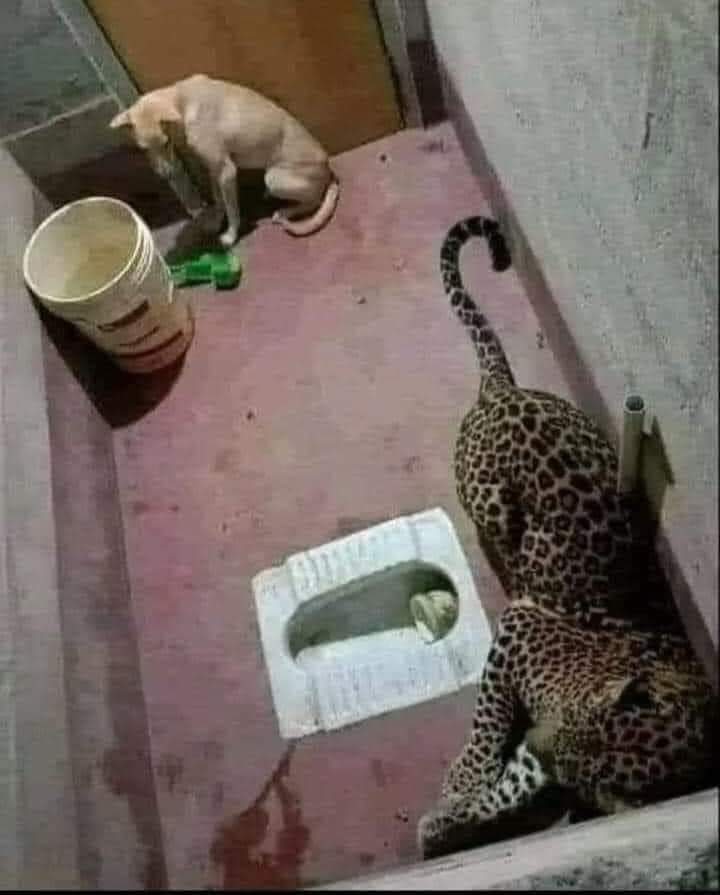
DHARMA


Came across a news item circulated in Whatsapp as below:


"In the Indian state of Karnataka, a leopard was chasing a dog to eat it, but the dog ran and jumped into the toilet of a government rest house, whose door was locked from the outside. The leopard also entered the toilet but both got trapped. The dog saw the leopard and sat quietly in a corner, waiting for the leopard to attack. Both animals stayed in different corners for about 12 hours. Then, the forest department team used a tranquilizer dart to capture the leopard and release it. The question is, why didn't the hungry leopard eat the dog, even though it was chasing it to eat, and could have easily done so in the locked toilet?"

-      I was reminded of another photo and news item where a Cheetah was kept in a cage near three other cages in which three dogs were also kept and when they were all released, when the dogs lunged forward, the cheetah had kept quiet.  The message said that the cheetah was not ready to prove its speed, just for a race.

While the Cheetah might have signaled ‘self respect’, the behavior of the leopard when it was trapped along with a prey it was pursuing, is intriguing.

On one hand, the pose of the dog, putting it’s head down, expecting to be attacked any moment by it’s expected predator, is heart rending.  On the other hand, the pose of the leopard lying in the other corner, perhaps expecting to be killed or trapped any moment is also hear rending.

The question as to why the leopard did not kill it’s prey, could be answered only by the probability that it knew about the trap and was fearing for it’s own life. The second possibility is it did not want to hunt a trapped prey?

Of course, had it been a man, in the place of the leopard, perhaps, even at that moment, he would have preferred to make best use of the opportunity and would have had a go at the prey.

Animals after all are seen to have some ground rules - DHARMA.


Tuesday, July 2, 2024

CHILD PLAY


CHILD PLAY


Children play
on the sea shores.

They run around,
Fall and rise,
Wet their feet’
In the graceful waves.

Children play
on the sea shores.

With the sand that was kissed
By repeated waves,
They build their house
With tiny hands.

Children play
on the sea shores.

When the waves advance
And touch their house
Or dash them down
They weep and yet,

Children play
on the sea shores.

Again and again,
They build houses,
With wet sand and
Tiny hands,

And Then when
roaring waves advance,
They jump aside,
And clap with glee

Even as the houses
Built by them
Are swept away
Without a trace.

Children play
on the sea shores.

When they grow up,
They walk around,
Lie on the sand
Stare at the sky.

Other children play
on the sea shores.

Then they watch
Other children build
Houses in sand
And the waves
Washing them away.

They smile at the games
other children play, for
‘Building houses in sand
Is better than castles in the air’.

Houses get built
Again and again
With wet sand and
Tiny hands,
Get destroyed
Again and again
By the raiding tides,
Without respite.

Still children play
And people watch
The endless game
With the endless waves.

Children still play
On the sea shores.


#Democracy and what it really should enable

We celebrate the surpassing of the record of #PanditNehru by #Modiji in terms of the number of days of remaining Elected Prime Minister for ...